


 Smart card manufacturers face a materials dilemma. As the industry moves away from virgin PVC toward alternatives like recycled PVC, PLA, rPETG, and Parley Ocean Plastic®, bonding chips and sensors reliably gets harder, not easier. For R&D engineers, production managers, and procurement teams sourcing tapes for payment card and smart card lines, that often means qualifying a different adhesive for every card construction. Each new material tested is another tape to source, store, and manage, and another chance to grab the wrong one on the production. Worse, traditional adhesives were never built for these emerging materials, so for genuinely new substrates, none of the tapes already qualified may deliver the performance and reliability required.
The Push Toward Sustainable Card Substrates
Payment cards are changing fast. Card bodies once made almost entirely from virgin PVC now include roughly 25 percent recycled plastic content on average, and that share is projected to reach 80 percent by 2028. With roughly 4 billion payment cards produced worldwide each year, that shift touches enormous production volumes. Recycled PVC, PLA, rPETG, and ocean-bound plastics each bring their own surface chemistry, so an adhesive tuned for one substrate rarely performs the same on another. Card manufacturers running mixed-material lines end up stocking separate adhesive tape variants for each construction, adding complexity, inventory cost, and the risk of a mismatched material reaching the line.
DuploTEC® SBF: One Structural Bonding Film, Every Card Material
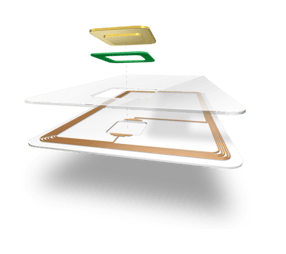
Lohmann's DuploTEC SBF range addresses this directly. It is a solvent-free, latently reactive polyurethane film built for chip and sensor bonding across virtually every common card substrate, including PC, rPVC, rPETG, PLA, and Parley Ocean Plastic®-based materials. Because one film adheres reliably across such a broad substrate range, production teams no longer need to switch adhesive systems every time a card construction changes. The film also activates at lower temperatures than traditional hotmelt tapes, protecting heat-sensitive materials while increasing efficiency on the line. It has already been proven in production with multiple global card manufacturers running PLA, R-PVC, and Parley Ocean Plastic® substrates, and it complies with Mastercard Card Quality Management requirements and relevant ISO standards.
 Choosing the Right Variant for Your Application
DuploTEC SBF comes in two variants, and the right one depends on what the chip
connection needs to do. The non-conductive version delivers strong mechanical bonding for chip embedding and general component integration, a good fit when the chip module does not need an electrical path through the adhesive layer. The anisotropic electrically conductive version combines the bonding strength with the ability to carry current in the z-direction, making it the choice for chip-to-antenna connections in dual-interface cards or for biometric sensor integration. Both variants are pre-applicable, dimensionally precise, and designed to run on existing card production equipment, so switching between suppliers does not require retooling your line.
Conclusion
Switching card materials should not mean switching adhesive systems every time. With DuploTEC SBF, smart card manufacturers get one bonding platform that adapts to PVC, PLA, rPETG, recycled content, and ocean-bound plastics alike, reducing tape variants, the risk of a tape mix-up on the line, but increasing efficiency. Our Cards & Security team works directly with manufacturers to match the right SBF grade to your card construction, from initial material testing through production scale-up. This hands-on application engineering support is part of what we call our Smart Bonding Approach, and it is available whether you are qualifying a new sustainable substrate or troubleshooting an existing line.
Have a specific application you'd like to discuss? Our experts are available for technical consultation — reach out and we'll take a look together.







-3.jpg?width=767&name=2026%20175%20Jahre%20Website%20(2)-3.jpg)