



When a pixel defect is detected at end-of-line quality control, a permanent bond leaves one option: scrap the entire display assembly - including fully functional frames, backlight units, and touch sensors. For display manufacturers, that outcome is increasingly unacceptable. Regulatory pressure from the EU Right to Repair Directive and WEEE, combined with rising display component costs, is pushing the industry toward a fundamental rethink of how adhesive systems are designed into display stacks.
Why debondable adhesive tapes are becoming a design requirement for display applications
Debonding on demand describes a category of adhesive systems engineered to maintain full performance throughout a product's service life - and then release residue free in a clean, controlled manner when required. The release can be triggered through a range of mechanisms: heat, UV radiation, stretching, solvents, or electrical current, among others. What distinguishes these removable adhesive tape solutions from simple repositionable products is that they are built to perform under the same demanding conditions as permanent bonds - vibration, thermal cycling, and mechanical stress - right up until the moment a deliberate release signal is applied. Lohmann's approach is structured around DIN/TS 54405, providing a standardized framework for specifying and validating debonding behavior across different trigger types and substrate combinations.
Segmented frame bonding: Where structural performance meets controlled release
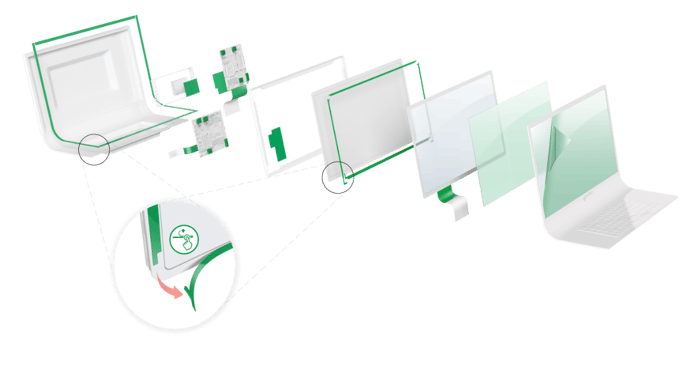 Display assemblies typically require bonding at the frame perimeter - securing glass panels, polarizers, and backlight modules within the housing structure. Lohmann's segmented frame bonding solutions address this interface directly. By applying debondable adhesive tape solutions in a segmented geometry rather than a continuous bond line, engineers gain both the structural integrity required for automotive cockpit displays, industrial HMI panels, or consumer device assemblies, and a defined release pathway when a component must be removed. This geometry also facilitates rework in production: when inline quality inspection flags a faulty panel, the display stack can be opened non-destructively, the defective unit separated, and working components returned to the production flow - reducing scrap and recovering value from expensive subassemblies.
Choosing the right debonding strategy
The appropriate debonding trigger depends on the substrate sensitivity, production environment, and end-of-life scenario. A practical framework for display applications: for rework in production, stretch-release or thermally activated debonding adhesive tapes for rework offer speed and process compatibility without chemical exposure. For repair and maintenance - whether in the field for automotive infotainment or in a service center for consumer devices - solutions that allow a technician to access a specific component cleanly without specialist equipment are preferable. For recycling and reuse of electronic devices, where the goal is material recovery at scale, thermally or radiation-triggered debonding adhesive solutions for the recycle and reuse of electronic components provide the most scalable process pathway, enabling separation of glass, touch sensors, and display modules without substrate damage.
Lohmann's application engineering takes debonding from concept to production
Selecting a debondable adhesive tape is the starting point, not the solution. Lohmann works with display manufacturers, OEMs, and Tier 1 and Tier 2 suppliers through co-development and customized solutions tailored to each assembly concept - from substrate compatibility testing to die-cut geometry, trigger mechanism validation, and full process integration support. With more than 700 bonding system variants and over 10,000 applications worldwide, Lohmann's application engineering teams bring both materials depth and production-line know-how to every project. Whether the challenge is an automotive display stack with pillar-to-pillar glass, a ruggedized industrial HMI, or a next-generation foldable consumer device, debonding on demand adhesive solutions can be integrated without compromising form factor, optical performance, or production throughput
Is there a specific application you would like to discuss? Our Lohmann experts are available for consultation - reach out and we'll take a look together.




-3.jpg?width=767&name=2026%20175%20Jahre%20Website%20(2)-3.jpg)