


Same problem space. Three different bonding applications.
An ostomy pouching system is not a single adhesive challenge. It is three distinct bonding applications in one device, each with its own substrate combination, mechanical loading profile, and performance requirement. An R&D engineer selecting adhesive components for a colostomy or ileostomy bag must think through each interface independently and find an adhesive supplier whose portfolio covers all of them without requiring three separate qualification processes.
Lohmann's DuploMED product range was developed from this device-level perspective. The portfolio covers base plate fixation to the hydrocolloid and the bag film, hook and loop closure systems for drainable pouches and for adhesive precision requiring die-cuts. Each application is addressed with a different material format, but all within a common framework: biocompatible components, EN ISO 13485-certified* manufacturing and availability in both roll and die-cut formats.
1: Base Plate Top Cover Fixation
2: Closure Systems
3: Die-Cut Components
Application 1: Base Plate Top Cover Fixation to the Ostomy Bag
Maintaining a reliable bond between the ostomy bag film and the baseplate is the structural foundation of every pouching system. The baseplate is the critical interface between the pouch and the hydrocolloid: It must withstand constant movement and maintain a hermetic seal throughout the entire wear period. A failure here is not a component issue. It is a device failure with immediate critical consequences.
Lohmann addresses this with PE foam tapes (DuploMED 22260 and DuploMED 22262) and EMA film solutions (DuploMED 23282) for applications where a thinner, more conformable profile is needed. Nonwoven-backed constructions (DuploMED 45150) are available where the design requires a specific surface texture or breathability characteristic at the bonding interface. It is also good to weldable to the base plate.
Application 2: Hook and Loop Closure Systems for Ileostomy Bags
A drainable ileostomy bag places very different demands on its closure system than a closed pouch. Through the liquid excretions the closure must open and close reliably across many cycles. It is a mechanical interface that the patient interacts with daily, often under conditions that make fine motor precision difficult. It must hold securely when closed, separate cleanly when opened, and survive the repeated mechanical cycling of daily ostomy management without losing its performance.
Lohmann's hook and loop portfolio for ostomy applications includes DuraHOOK 68104 and DuraLOOP 68014 and also DuraHOOK 140/03 and DuraLOOP 1381 — engineered specifically for this application. DuraHOOK is thinner and more flexible than traditional hook systems, with a mushroom head design that protects the landing zone (the loop material) from damage through repeated engagement. High peel and shear performance provides the reliable hold the patient depends on; the design geometry prevents the progressive degradation of the loop material that is a common failure mode in conventional hook systems.
The challenge is that the outer film of an ostomy pouch is a low surface energy barrier material — typically a PE or PP, multilayer construction chosen for its fluid management properties also odor management, not its adhesive receptivity. Getting a reliable, durable bond to this substrate requires an adhesive specifically formulated for low surface energy bonding, rather than a standard PSA reoptimized for cost.
The rubber-based adhesive formulations is available to match the OEM's substrate requirements and process conditions and is supplied in master rolls, slit rolls, and die-cut formats.
Application 3: Die-Cut Components for Ostomy Device Assembly
Not every bonding challenge in an ostomy pouching system is structural. A reliable device also depends on a set of smaller, precisely engineered components — each of which must perform consistently through the converting process and across the product's full service life.
Lohmann supplies die-cut solutions, next to Hook and Loop, for three more recurring application requirements in ostomy device manufacturing. These are manufactured in accordance with the requirements of EN ISO 13485* standard.
Charcoal filter mounting demands dimensional accuracy and reliable adhesion to both the filter element and the bag film. The filter's function depends entirely on a controlled gas flow path — any delamination at the mounting interface, or any dimensional inconsistency in the die-cut, compromises that function directly.
Pull tab systems must initiate a clean, controlled separation every time, under varying grip conditions. The adhesive and die-cut geometry work together here: the pull tab must release predictably without lifting surrounding laminate layers or leaving residue on the bag film. Lohmann supplies pull tab solutions as die-cuts on roll, ready for direct integration into the OEM's assembly line.
Outlet stiffeners provide structural reinforcement at the bag outlet. The area of the device subject to the most repeated mechanical loading during daily use. The stiffener must maintain its integrity through drain cycles without adding bulk that affects wear comfort or discretion.
All three formats are available in film and foam substrates, supplied as die-cuts on roll or in flat-sheet format to match the OEM's converting process.
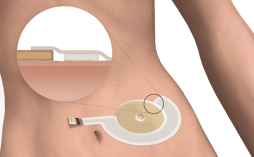
Beyond Bonding: Adhesive Solutions for Integrated Leak DetectionSensor-integrated ostomy devices — capable of detecting leakage before it occurs — are one of the more technically demanding bonding challenges in medical wearables. Achieving a reliable adhesive interface that enables controlled liquid detection with e.g. printed electronics, adapts to individual device geometries, and survives the full wear period requires a fundamentally different approach than standard baseplate or closure bonding.
This is not a catalog product — it is an application engineering engagement. |
What all the application have in common: The DuploMED Framework
Despite their different performance profiles, all application areas are served within a common product and quality framework. Most DuploMED ostomy products are biocompatible and manufactured in accordance with the requirements of EN ISO 13485* standard. All formats — whether PE foam tape, PU film tape, EMA film, nonwoven, hook tape, or loop tape — are thoroughly tested for compatibility and reliability with the most commonly used ostomy bag materials. All are available in roll and die-cut formats to integrate into the OEM's existing production process without requiring new converting investment.
As a fully integrated supplier, Lohmann manages the complete development arc: from material selection and adhesive formulation, through coating and converting, through to packaging and delivery. The project management methodology — FMEA, risk assessment, design of experiments — is standard practice, not an optional service tier.
Is there a specific application you would like to discuss? Our Lohmann experts are available for consultation — reach out and we'll take a look together.
*= certification limited to design and development, manufacture and distribution of adhesive tapes for medical devices




-3.jpg?width=767&name=2026%20175%20Jahre%20Website%20(2)-3.jpg)