


From 1-day delivery to 28-day monitoring - one adhesive partner for every wear time and the complexity that comes with it
As medical wearables demand longer wear times and greater discretion, adhesive performance and supply chain complexity rise in lockstep. Here's how a single-partner strategy changes the equation.

Medical wearables are getting smaller. CGM sensors that once required a full patch system now sit discreetly on the upper arm. Insulin patch pumps have shrunk to the point where patients forget they are wearing them. The engineering behind this miniaturization is impressive. But it has created a problem that doesn't show up on a device specification sheet: as the device gets smaller, the adhesive must perform better — and managing the supply chain complexity behind that adhesive becomes significantly harder.
For R&D teams and procurement managers at CGM device and insulin patch pump manufacturers, the adhesive component often involves multiple suppliers: one for the skin-contact layer, one for the device bonding layer, one for the die-cut converting, potentially another for regulatory documentation support. Each handoff is a communication risk. Each qualification is a timeline event. Each supplier change notification is a design dossier problem.
Lohmann's approach to the wearables market starts from a different premise: one partner, across the full adhesive value chain.
The Two Bonding Challenges in Every CGM and Patch Pump Device
Every medical wearable that adheres to the body presents two distinct adhesive engineering problems, and they pull in different directions.
The skin-contact layer must bond reliably to human skin, across skin types, across activity levels, across perspiration, across the full intended wear duration. For a CGM device targeting 14-day wear, this means maintaining adhesion through showering, exercise, and the natural variation in skin surface chemistry between patients. For an insulin patch pump usage over a shorter delivery window, but in both cases, removal at end of use must be painless and residue-free - for patient comfort, but also because skin damage from repeated adhesive trauma is a clinical complication, not just a user experience issue.
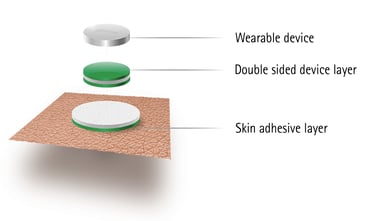
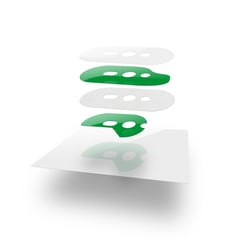
The device integration layer must bond the sensor or pump electronics to their housing, membranes, and functional components reliably, without introducing contamination, and with a profile that survives the mechanical and thermal demands of the device's service life. This layer also increasingly needs to serve as a protective barrier: as devices integrate printed electronics, the adhesive between the electronics and the skin-contact surface must prevent moisture ingress while maintaining the dimensional stability the device's measurement accuracy depends on.
These two challenges require different adhesive chemistries, different carrier materials, and often different converting approaches. Managing them through separate suppliers creates exactly the communication and risk exposure that device manufacturers are trying to avoid.
Wear Time as a Design Parameter, Not a Marketing Claim
One of the most consequential decisions in CGM device development is wear time. It determines the adhesive specification more than almost any other design parameter — and it is a decision that should be made in close collaboration with the adhesive partner, not after the device architecture is already fixed.
Lohmann's DuploMED product range for skin-contact wearable applications is structured around wear time categories, because this is how device engineers actually think about the problem:
|
Wear Time |
Products |
Application |
Key Performance Profile |
|
Short (1–2 days) |
DuploMED 22260 DuploMED ELE 77300
|
Large volume injectors, short-term drug delivery |
High initial tack, low peel force for easy removal, good shear resistance during injection |
|
Medium (3–7 days) |
DuploMED 45150 DuploMED 45300 DuploMED SUR 62410 |
First-gen CGM, cardiac monitoring patches |
Multi-cycle moisture management, clean end-of-wear release, breathability to prevent skin maceration |
|
Long (14+ days) |
DuploMED 22791 |
Current CGM platforms 14-day wear standard |
Highly flexible backing adapts to skin movement, good breathability, reliable adhesion across all skin types |
|
Extended (28+ days) |
DuploMED 85300 |
Advanced long-term monitoring wearables |
Strong adhesion on challenging skin types, ISO 10993 biocompatibility certified, engineered for frontier wear durations |
The wear time framework is the starting point for a development conversation. A CGM manufacturer who has committed to a 14-day wear claim needs to know that DuploMED 22791's highly flexible backing material and breathability profile are the design foundation for that claim — not a secondary specification to be confirmed after the device architecture is locked.

Is there a specific application you would like to discuss? Our Lohmann experts are available for consultation — reach out and we'll take a look together.



-3.jpg?width=767&name=2026%20175%20Jahre%20Website%20(2)-3.jpg)