


The bonding challenge no standard tape can solve
Most adhesive applications tolerate an occasional failure. A label delaminates. A panel bond creeps. The consequences are operational — costly, certainly, but correctable on the next production run.

Ostomy device bonding is categorically different. When the adhesive in a pouching system fails — whether at the baseplate-to-hydrocolloid interface or at the closure system — the consequences are immediate and personal: leakage, peristomal skin breakdown, patient distress, and a product return that damages a brand far beyond any specification gap on a datasheet. The adhesive is not a supporting component in a colostomy or ileostomy device. It is, functionally, the device.
For R&D engineers and product managers at ostomy device manufacturers, this creates a design and sourcing challenge that sits entirely outside the competency of most adhesive suppliers. The technical requirements are specific, the regulatory obligations are real, and the substrate challenges are ones that standard industrial PSAs were never developed to address. Understanding exactly what makes ostomy device bonding its own adhesive category is the necessary first step before any product selection or supplier engagement begins.
The first problem: Ostomy bag materials are not designed to bond
Ostomy bag raw materials — primarily polyethylene and polypropylene barrier films — are selected almost entirely for their barrier properties. Odor containment, fluid impermeability, gas management: these are the performance drivers for the bag manufacturer. Bondability is rarely in the specification.
The practical consequence is that these materials have low surface energy. They are, by their nature, resistant to adhesive wetting. An adhesive that performs excellently on a metal panel, a lacquered surface, or a rigid plastic housing will frequently fail on the PE or PP film of an ostomy pouch — not because the adhesive is inferior, but because it was never formulated for this substrate category.
Lohmann's approach to the ostomy market begins precisely with this challenge. The DuploMED adhesive product range for ostomy applications was developed specifically to ensure both patient comfort and long-term device performance for the needs of sensitive and stressed skin, offering high breathability, water resistance as well as an almost residue-free and painless removability.
The second problem: Every interface in the device stack must hold
An ostomy pouching system is not a single-adhesive application. There are multiple bonding interfaces, and each one carries a distinct performance requirement.
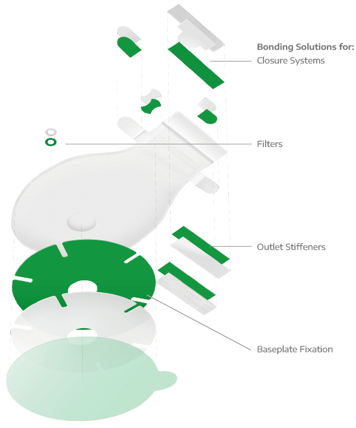 The baseplate-to-bag bond is the primary structural interface. The baseplate acts as the critical link between the pouch and the hydrocolloid, and it must withstand constant movement — postural changes, physical activity, the mechanical loading that comes with an active daily life. A failure here is a catastrophic device failure. PE foam tapes, EMA films, and nonwoven-backed adhesives each have a role depending on the system architecture and the stiffness balance the manufacturer is targeting.
The closure system on a drainable ileostomy bag is a different design challenge entirely. Hook and loop systems here must provide security, ease of use, and the durability to perform through repeated open-and-close cycles over the device's wear life. A closure system that loses its grip after a few cycles, or that is too aggressive for clean separation, is a user experience failure — and in an ostomy context, user experience is a critical outcome.
Die-cut components — charcoal filter mounting, pull tab systems, outlet stiffeners — add further adhesive precision requirements. Each must be dimensionally exact and must perform without delamination through the converting process and the product's service life.
|
DuploMED OSTOMY at a glance |
The third problem: regulatory expectations are not optional
Skin-contact adhesive components in ostomy devices are components of medical devices. As an experienced manufacturer of adhesive tapes for medical devices we are aware of the responsibilities of the device manufacturer. For this reason we maintain a supporting documentation, including biocompatibilit evidence.
This biocompatibility is a technical and regulatory requirement that must be supported by testing. Most DuploMED ostomy products from Lohmann are biocompatible and manufactured according to EN ISO 13485* standards — the international quality management system standard for the medical device supply chain. This is the baseline expectation, not a differentiator.
What differentiates an adhesive partner in this environment is the depth of documentation they can provide: whether their quality management system generates the records that integrate into the OEM's technical file, whether they have a defined change notification protocol, and whether they can support the IQ/OQ/PQ validation process that regulated manufacturers are required to conduct. An adhesive supplier who cannot engage at this level of documentation creates a compliance gap in the manufacturer's design dossier.
What 'specialized' means in adhesive terms
The word 'specialized' has become diluted in industrial marketing. In the context of ostomy device adhesives, it has a precise technical meaning.
It means adhesive formulations that achieve reliable wetting and adhesion on low surface energy substrates — not as a workaround, but as a designed primary function. It means carrier selection (foam, film, nonwoven) that matches the mechanical requirements of the bonding interface, not just what is available in a standard catalog. It means biocompatibility documentation that is already prepared for EN ISO 10993 review, not assembled retrospectively when an audit demands it.
It also means a supplier infrastructure that can support the full development arc, from initial material selection and prototyping through validated production, with FMEA and risk assessment integrated as standard process steps, not as add-ons requested at the end.
The ostomy device market rewards legal manufacturers who understand that the adhesive component is not peripheral to the device's clinical performance. It is central to it.
Is there a specific application you would like to discuss? Our Lohmann experts are available for consultation — reach out and we'll take a look together.
*= certification limited to design and development, manufacture and distribution of adhesive tapes for medical devices



-3.jpg?width=767&name=2026%20175%20Jahre%20Website%20(2)-3.jpg)