


PART 5 I Extended Color Gamut printing has moved from niche technique to mainstream consideration faster than most people expected. If you're working in flexible packaging or labels, ECG is likely already part of your customer conversations — or will be soon. This article covers what it actually is, what makes it operationally attractive, and where the process creates demands that conventional flexo doesn't.
From Four Colors to Seven — What Changes
Conventional flexo printing works with CMYK, supplemented by spot colors mixed specifically for each brand's palette. ECG expands that to a seven-color fixed ink set — typically CMYK plus Orange, Green, and Violet — capable of reproducing a much wider range of Pantone colors without changing inks or anilox rollers between jobs.
The operational logic is straightforward: because the same ink set and anilox configuration runs across multiple jobs, converters can dramatically cut the downtime associated with ink changeovers, wash-ups, and cleaning. Color vibrance improves as well — a seven-color ECG process can typically reproduce around 90% of the Pantone color library, compared to roughly 45% for conventional four-color printing.
That expanded color range makes ECG particularly compelling for luxury beauty and cosmetics packaging, where subtle shadow detail and lifelike color accuracy are directly tied to brand perception. It also supports the shift toward shorter, more efficient runs: without ink and anilox changeovers, converters can compete more effectively with digital short-run printing while retaining flexo's cost advantages at scale. And from a sustainability standpoint, a fixed ink set generates less pre-mixed ink waste — less disposal, smaller environmental footprint per job.
 |
#FLEXpert Tip |
The Challenge Hidden Inside the Opportunity
Here's what makes ECG fundamentally different from conventional flexo — and why it creates a narrower margin for mechanical variability. In ECG printing, brand spot colors aren't printed directly. They're simulated through an overlay of up to three color separations layered precisely on top of one another. That simulation only works if dot gain stays consistent throughout the run.
Dot gain — the tendency of ink to spread as it transfers from plate to substrate — is the variable that ECG color simulation cannot absorb. If dot gain shifts, even slightly, the simulated spot color drifts away from the target Pantone value. The result is color inconsistency across the run: the kind of mismatch that generates customer complaints when a shipment doesn't match a brand's established color standard.
In conventional flexo, minor dot gain variation is absorbed. In ECG, it's amplified — because the color is being reconstructed, not printed directly.
The moments when dot gain is most likely to vary are predictable: press run-up, as speed ramps to production velocity; temperature stabilization, as rollers and inks reach operating conditions; and impression pressure settling, as the press finds its steady-state engagement. These aren't avoidable phenomena — they're a normal part of every print run's startup phase. The question isn't whether they'll occur, but whether the printing system can absorb them without compromising color accuracy.
In conventional spot-color printing, this variability typically falls within a margin the process can absorb. In ECG, that margin is tighter — and the tolerance for mechanical inconsistency is correspondingly lower throughout the entire printing system.
The Tone Value Curve — Reading Tape Quality in the Data
One of the clearest indicators of tape performance in an ECG environment is the tone value progression — the print characteristic curve that maps how dot sizes reproduce across the tonal range from highlights to shadows.
For ECG to work as intended, that curve needs to behave in a specific way. The tonal values should reproduce as harmoniously as possible, which means the characteristic curve should be as monotonic as possible — no reversals in the bend that would indicate inconsistent compression behavior at specific tonal ranges. Critically, the curve should track close to the angle bisector, particularly in the highlight tones where ECG's color simulation is most sensitive to deviation. And perhaps most telling: a well-specified tape produces a characteristic curve that responds as independently as possible to changes in press speed and impression engagement settings. If the curve shifts significantly when speed or pressure changes, the tape is amplifying variability rather than absorbing it.
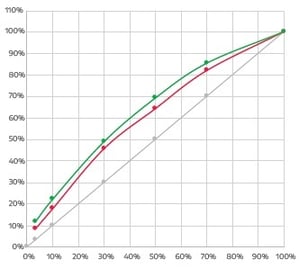
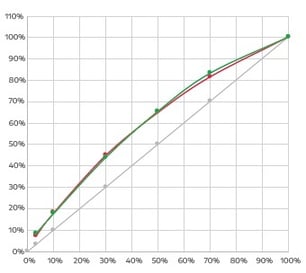
Tone value progression comparison — standard tape (left) vs. high-quality tape (right)
Substrate: LD-PE film, 50 µm, white, 800 mm wide
Press: Bobst Flexpress 6S/8
Red: press speed 100 m/min
Green: press speed 200 m/min
The difference between a well-specified tape and a generic alternative is visible in the data. A high-quality tape produces a smooth dot gain curve close to the angle bisector — consistent, predictable, and largely independent of speed changes. A tape that isn't matched to the demands of ECG shows higher overall dot gain, less harmonic curves, and a characteristic curve that reacts sensitively to changes in press speed. In an ECG run, that sensitivity translates directly into color drift — and color drift translates into customer complaints and scrap.
This is the kind of evidence we look at when supporting customers through an ECG tape specification. The characteristic curve doesn't lie — it shows you exactly how the tape is behaving under production conditions, and whether its compression and recovery behavior is holding the process steady or introducing variability into it.
|
#FLEXpert Tip |
Have a specific application you'd like to discuss? Our FLEXperts are available for technical consultation — reach out and we'll take a look together.
Coming up in PART 6: What ECG's tighter tolerance for variability means for your plate mounting tape — and why the specification decisions covered in Parts 3 and 4 matter more than ever in an ECG environment.





-3.jpg?width=767&name=2026%20175%20Jahre%20Website%20(2)-3.jpg)