


PART 4 I In Part 3, we looked at how the foam and film work together as a laminated construction - and why the full tape architecture shapes performance in ways that foam hardness alone doesn't predict. In this article, we go one level deeper: into the foam itself. Specifically, into cell size the structural variable that determines how consistently and how durably a foam delivers its specified compressibility under the demands of a real print run.
Most operators are familiar with foam hardness as a selection variable. Fewer think about cell structure. But cell size is one of the most consequential details inside a plate mounting tape and understanding it changes how you evaluate the foams you're working with.
What Foam Actually Is
The most commonly used foam used in high-performance plate mounting tapes is a closed-cell polyethylene (PE) foam - a cellular plastic produced by introducing a blowing agent into molten PE, causing it to expand into a network of small, gas-filled cells encapsulated by thin polymer walls. Closed-cell means those gas pockets are sealed: each cell is self-contained, which gives the foam its controlled compressibility and recovery behavior.
For demanding flexo applications, crosslinked PE (XLPE) is the standard - crosslinking allows much tighter control over cell formation during production than non-crosslinked PE, resulting in finer, more uniform cell structures and better fatigue resistance over long runs. But crosslinked PE is a category, not a fixed quality level.
Two foams can both legitimately be called crosslinked PE foam while differing significantly in actual cell size, uniformity, and recovery behavior depending on the formulation, crosslinking method, and manufacturing process control used. In practice, this means evaluating a tape by material category alone isn't enough. The specific foam grade and the cell structure it delivers is what determines real-world performance.
 |
#FLEXpert Tip |
How Cell Size Governs Compressibility

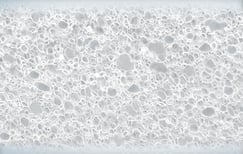
Very fine-celled foam vs. fine-celled foam
It's also worth separating cell size from foam density: two foams can share the same density - and therefore the same nominal hardness - while having different cell sizes. They will perform differently in the impression zone. A fine-celled foam at medium hardness is not the same tape as a coarser-celled foam at the same hardness. Cell size is the structural detail that determines how consistently the foam delivers on its specified compressibility and in demanding flexo applications, that detail matters.
| |
#FLEXpert Tip |
Fine-Celled Foam: Built for the Vast Majority of Jobs
A genuinely high-quality, fine-celled crosslinked PE foam already covers most of what flexo printing demands. Because load is spread across so many small cells, the compressive response stays smooth and proportional. And because each cell holds a small gas volume, the energy stored during compression is modest and releases gradually on recovery giving controlled, consistent recovery between impressions. At press speeds where the tape compresses and recovers thousands of times per minute, that recovery behavior matters as much as the compression itself.
For fine screen and halftone work in particular, a well-made fine-celled foam is the right specification: it supports longer, faster runs while holding consistent print definition and keeping dot gain under control. Because the cell structure is uniform, every part of the plate surface receives essentially the same impression treatment avoiding the localized pressure peaks that would crush highlight dots in one area while under-impressing solids in another.
For the great majority of flexo jobs, a high quality fine-celled foam isn't a compromise. It's the correctly specified, well-performing solution.
Where Very-Fine-Celled Foam Earns Its Place
The case for going a step further into very-fine-celled foam is narrower and more specific. Bounce is a dynamic problem rather than a static-compression one: the foam has to track rapid, low-amplitude oscillations in the nip gap in real time. A fine-celled foam handles this well, but a very-fine-celled structure spreads the same cyclic load across an even larger number of smaller deformation sites, keeping the dynamic response closer to ideal under rapid, repeated loading. In effect, the extra fineness raises the threshold at which mechanical vibration becomes visible as banding in the print.
This matters most in situations operating close to their margins: jobs with challenging designs - wide bars, large open areas, significant gaps in plate coverage - a press with some bearing wear or cylinder run-out that's crept slightly out of spec, or a job running near the top of the speed range the line can handle. In those situations, the additional dynamic uniformity of a very-fine-celled foam can be exactly what keeps a borderline vibration defect below the threshold of visibility.
Long runs compound this. Bounce resistance depends on cells recovering fully between impressions, and that capacity erodes as cell walls accumulate fatigue from repeated compression. Because a very-fine-celled foam spreads strain across more, thinner-walled cells, each wall carries less strain per cycle so the foam holds its vibration-damping performance over a larger share of a long run before fatigue starts to show.
| |
#FLEXpert Tip |
Matching Cell Structure to the Job
Finer cell structure is not always better - it's more demanding to produce consistently, and its advantages are most relevant in specific situations.
The decision follows a clear logic:
- For most flexo jobs - halftones, process work, combination prints running on well-maintained equipment - a quality fine-celled crosslinked PE foam is the right specification. It delivers consistent compressibility, controlled recovery, and reliable performance across a broad range of conditions.
- For bounce-prone jobs - presses operating near their mechanical limits, or extended runs where fatigue resistance matters - very-fine-celled foam is the more precise tool. The additional structural fineness changes the outcome in exactly these situations.
The connection back to the earlier foam hardness discussion is worth making explicit one more time: cell size and foam density are related but not the same variable. Hardness tells you how much the foam resists compression. Cell size tells you how evenly and how durably it does so. In demanding flexo applications, both matter and specifying one without understanding the other leaves performance on the table.
Have a specific application you'd like to discuss? Our FLEXperts are available for technical consultation — reach out and we'll take a look together.
Coming up in PART 5: ECG Printing: What it is, why it's growing, and where the process gets demanding.





-3.jpg?width=767&name=2026%20175%20Jahre%20Website%20(2)-3.jpg)