 You've picked your sensing method: ECG, respiratory monitoring, EEG, or bioimpedance or other vital signs. Then a simple question lands in the project meeting. How long does the patch have to stay on? A few hours in a clinic? Five days at home? Four weeks?
If you work in R&D, product development, or design engineering at a medical device company building smart wearables, you know the answer shapes almost everything downstream. Yet it often gets settled late, after the sensor design is frozen. Wear time deserves one of the first slots on your requirements list.
Why Wear Time Drives Medical Wearables Design
Monitoring has moved a long way from the classic Holter monitor, which stays on for one or two days and usually connects to a recorder through wires. Mobile cardiac telemetry uses a small portable device instead and tracks constantly medical grade vital parameters over several days or weeks. That's a very different job for the skin interface.
Lohmann's wearable sensor solutions cover wear times from a few hours to up to 28+ days, including short (1 to 2 days), medium (3 to 7 days), extended (10 – 15 days) and long wear (up to 28+ days). Every extra day adds sweat, movement, and clothing friction. It also adds data. Validated wearable performance can lower total treatment cost and improve medical data quality, since fewer lifted patches mean fewer gaps and fewer replacements. The catch: a patch worn for weeks has to feel so comfortable that your patient forgets it's there. Otherwise it is taken off too early, and the long monitoring period never happens.
Material Choices for Medical Wearables: ECG, EEG and Bioimpedance Patches
 Signals only count if skin contact stays stable. So the whole stack matters: skin adhesive, flexible and breathable backing, and the conductive layer to connect the functionality. Lohmann builds smart health patches with stretchable materials, breathable substrates - robust for every day life. Sensors and circuits connect to conventional electronics, and a possible combination of SMDs with printed electronics adds further functional options.
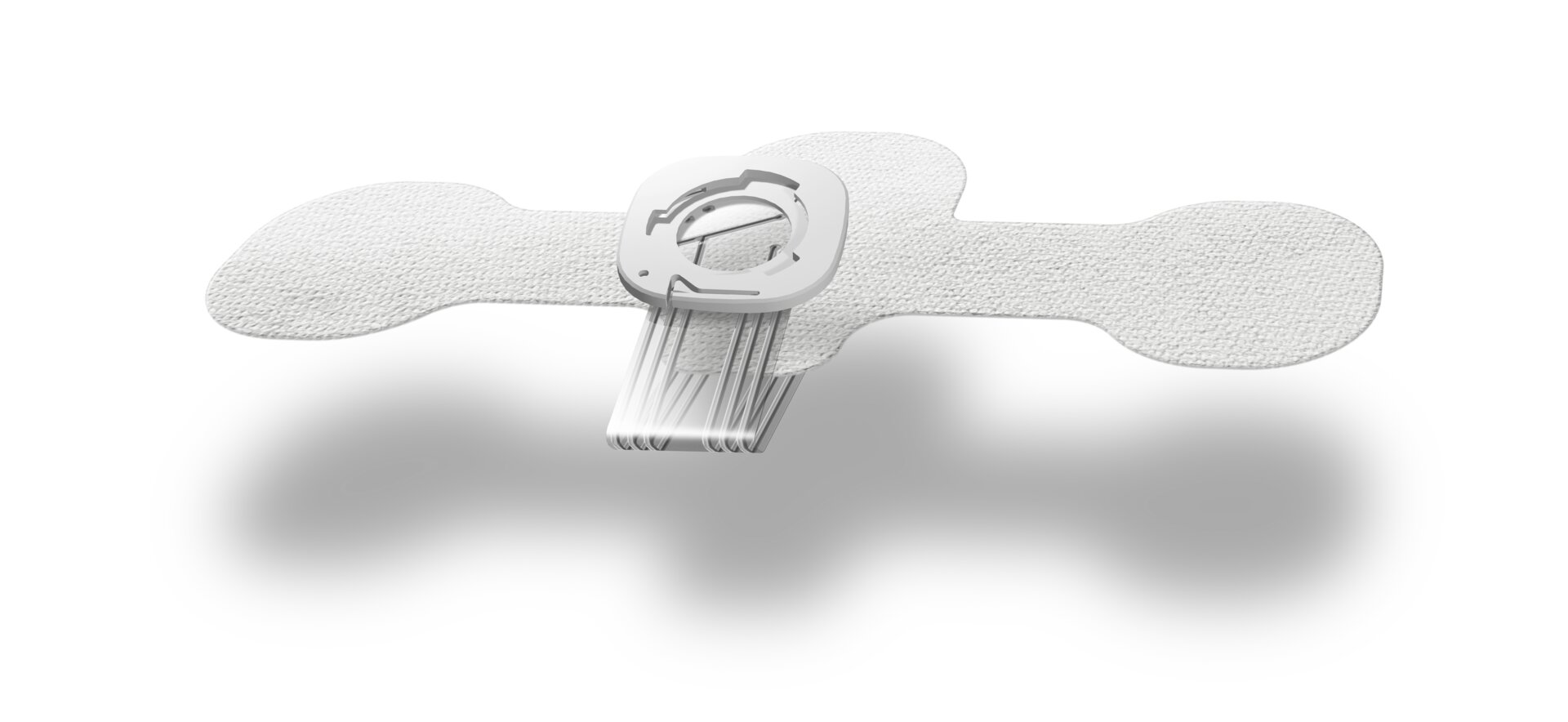
A concrete example is our skin impedance spectroscopy development platform as a ready to use patch. It has two measurement channels that share a center electrode. It pairs with Lohmann DuploMED 45150 for 5 to 7 days of wear. For longer monitoring, our Longwear skin adhesive DuploMED 85300 is designed for up to 28+ days of wear. It's breathable (MVTR above 250 g/m²/day), water resistant, and biocompatible according to ISO 10993. The materials stretch enough for different body positions.
How to Set Health Patch Requirements Before You Prototype
Start with the target wear time, then work backward. Hours to a few days? A lighter stack may do. Five to seven days? DuploMED 45150 is a sensible starting point. Four weeks or more? Look at Longwear skin adhesive DuploMED 85300 and plan a breathable backing early, because both affect comfort as much as hold. We will support you with layering and stacking these materials and optimization of the patch design to allow highest comfort.
Next, write down the wear location and how much the body moves locally. Then define which signal has to cross the patch. Finally, decide where you'll produce. Manufacturing in high-wage countries only pays off with efficient, high-quality processes, so check that your partner can build in your key regions and scale from small runs to large volumes.
Plan Your Health Patch with Lohmann at MEDICA 2026
Wear time, signal type, and skin comfort belong in one conversation, ideally before the first prototype. That's where a CDMO (contract development and manufacturing organization) partner earns its place. Lohmann acts as a certified development partner from the first functional demonstrator to the scaled product, with wearable-optimized materials and manufacturing in all relevant regions.
Meet our Health Team at MEDICA 2026, November 16-19, hall 12, booth 12D54, at the Wearable Technologies booth. Book a meeting at at our booth here or explore our health patch solutions.