


PART 3 I In Part 2, we unpacked foam hardness — and why the soft-medium-hard shorthand only tells part of the story. There's another variable inside every high-performance plate mounting tape that operators rarely think about. It's the reinforcing film — and understanding how it works together with the foam is the next step toward a genuinely informed specification decision.
Every plate mounting tape is a laminated construction. The foam is its core and as we discussed in Part 2, foam quality remains the primary factor in print performance. But the foam doesn't work alone. Running through the tape structure is a reinforcing film, and this film fundamentally changes what the tape can deliver. The combination of foam and film, how they are engineered together, is what determines real-world performance under production conditions.
Why Foam Alone Isn't Enough
On its own, foam is compliant by nature. It will stretch, compress laterally, and distort if asked to do too much. Without a structural layer working against it, even well-engineered foam can lose dimensional consistency — varying slightly in caliper across the roll width, or elongating under the tension of mounting.
The reinforcing film counters this. It introduces dimensional stability into the construction: resistance to stretching along the tape's length, resistance to buckling under side loads, and consistent caliper across the full roll. Think of it as a partnership of opposites. The foam brings cushion, conformability, and controlled compressibility. The film brings rigidity, precision, and the structural backbone that keeps the foam in shape.
Neither is sufficient alone. Together, they define what the tape can actually deliver under the demands of a real print run — which is why evaluating a plate mounting tape by foam hardness alone misses half the picture.
 |
#FLEXpert Tip |
How Film Architecture Shapes Performance
These are not abstract engineering distinctions. They translate directly into how the tape responds to specific job requirements.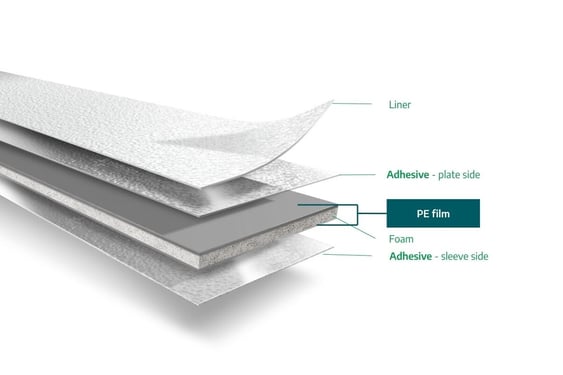
Bounce: The Test That Reveals the Construction
Of all the performance variables in plate mounting, bounce is the one that most clearly exposes the difference between tape constructions. It occurs when the design shows a plate edge, a cut-out, or a low-image area, that causes a sudden release and re-engagement of impression pressure as the cylinder rotates. That re-engagement sends a shock wave through the mounting system. If it isn't absorbed, it shows up as banding or streaking in the printed image.
Stiffness transmits the shock. Flexibility absorbs it.
A construction that prioritizes rigidity will conduct that impact energy efficiently through the tape and into the plate surface, amplifying rather than damping the bounce effect. A construction engineered for energy absorption works differently: the foam compresses, the film flexes, and between them the impact energy is spread and dissipated rather than transmitted. The result is measurably less banding, cleaner image edges, and greater stability in the impression zone, particularly on jobs with open plate layouts or significant areas of missing coverage.
This is not a marginal difference. On bounce-prone jobs, the choice of tape construction can be the deciding factor between acceptable and unacceptable print quality — even when everything else on the press is set correctly.
| |
#FLEXpert Tip |
The Construction Is the Specification
The practical implication of all of this is straightforward: selecting a plate mounting tape is not just a matter of choosing a foam hardness grade. The full laminate construction — how the foam and film are engineered together, and for which performance priorities — needs to match what the job actually demands.
A tape optimized for rigidity and dimensional control will perform differently from one optimized for conformability and energy absorption, even at the same foam hardness. Understanding which set of properties your application requires is the specification decision that matters.
Our FLEXperts work through exactly this kind of analysis with customers every day. If you're working through a tape specification and want to understand which construction fits your application, we're happy to take a look together.
Have a specific application you'd like to discuss? Our FLEXperts are available for technical consultation — reach out and we'll take a look together.
Coming up in PART 4: Inside the foam: How cell size influences bounce behavior, and what that means for your tape specification.





-3.jpg?width=767&name=2026%20175%20Jahre%20Website%20(2)-3.jpg)